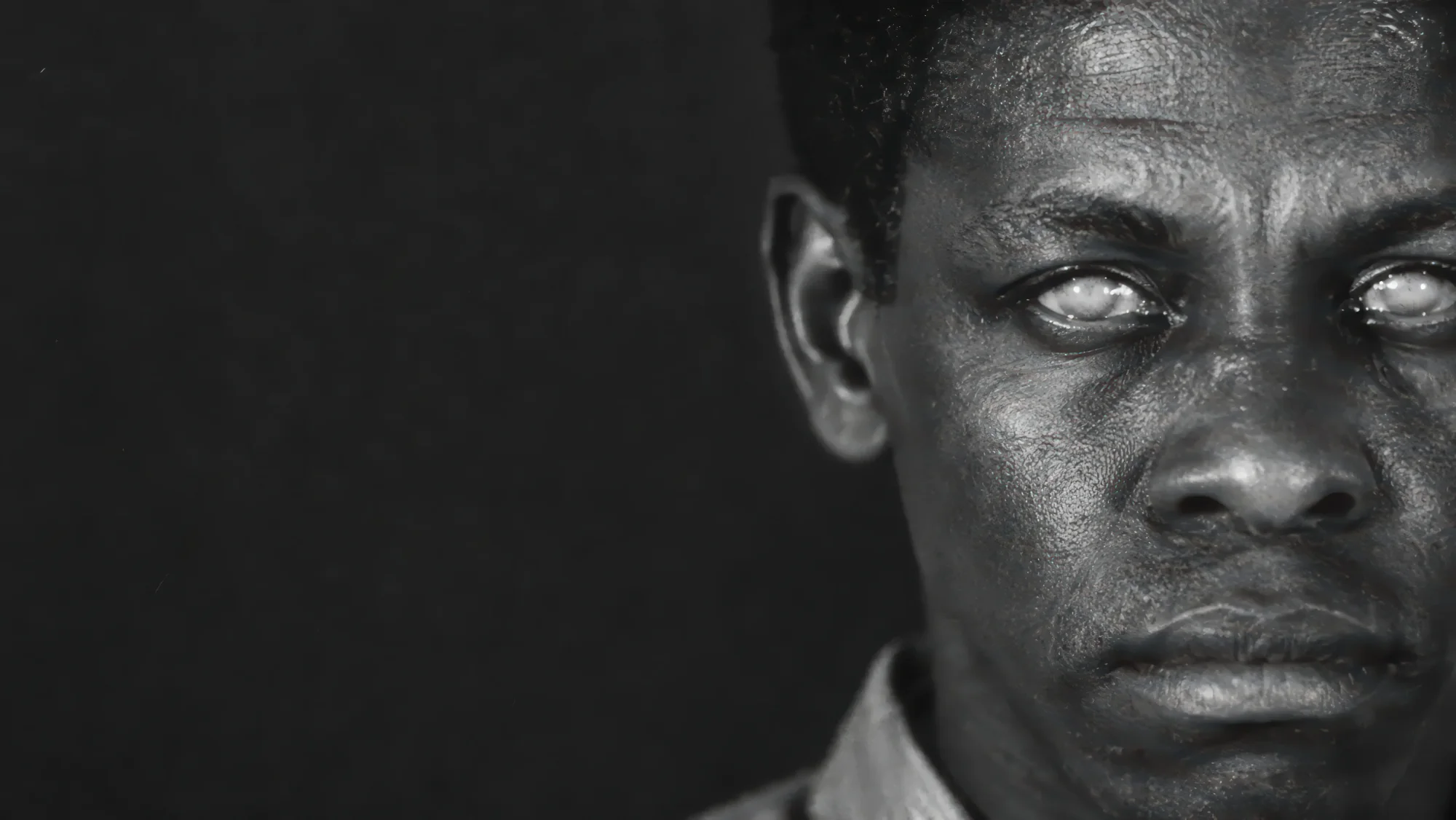
In 1945 Illinois, a nurse struggles to reach an unidentified Black man who is blind, deaf, and mute. Through a private language of breath and touch, two wounded souls become the unlikely means of each other’s healing.
Illinois, 1945.
At a state institution, an unidentified young man arrives with little more than a number: John Doe No. 24. Blind, deaf, and unable to speak, he has no means of communicating who he is or where he came from.
On the same day, Tillman Shay, a British woman carrying wounds from her years as a wartime nurse, begins work at the institution. Assigned to John Doe, she senses beneath his isolation a fully conscious human being whom everyone else has dismissed.
Without words or images, the two begin the delicate work of finding one another. A breath against skin. A hand offered rather than imposed. A touch answered by another.
Tillman cannot know his name or restore what has been taken from him. But her determination to reach him becomes an intimate and silent language all their own.
When the institution threatens to separate them, Tillman fights to protect the fragile connection they have created.
At stake is nothing less than saving each other.
Director’s Statement
Statement
Some stories arrive quickly.
Others refuse to let go.
John Doe No. 24 has lived quietly inside me for nearly thirty years, ever since I first encountered his true story through the transcendent song released by Mary Chapin Carpenter in 1994 - a year after a brief New York Times obituary announced the death of a blind, deaf, and mute man found abandoned in 1945 who spent the remainder of his life within the Illinois state institutional system.
I have never been interested in solving the mystery of his name or where he came from. The question that stayed with me was far more elemental: how do you reach a human being when every conventional means of reaching him has been taken away?
To explore that question, I imagined John Doe’s first weeks at the Lincoln State School and Colony and the woman who might have discovered the person everyone else had stopped looking for.
Tillman and John Doe enter each other’s lives carrying wounds neither can express. She possesses every conventional means of communication yet cannot speak about what has happened to her. John Doe possesses none of them, yet remains intensely alive within a consciousness the world around him doesn’t acknowledge.
I want the audience to experience the distance between them and then, almost imperceptibly, watch that distance disappear.
There are no exchanged glances. No conversation. Instead, the grammar of the film becomes physical: air moving across skin, the pressure of a fingertip, the hesitation before a hand is accepted. As their language develops, the camera moves closer and what initially appears to be silence becomes filled with information.
Silence has weight and touch has consequence. Breath becomes an event.
The performances will live at that same scale. A tightening hand, a change in breathing, the smallest movement of a face will carry what dialogue ordinarily would. I want the audience leaning toward these two people rather than having the film sentimentally push emotion outward.
Ultimately, John Doe No. 24 is a quiet film about something enormous: the human need to be known.
Tillman recognizes an entire human being inside John Doe’s silence. And in reaching for him, she finds her way back to herself.
Tone
Intimate, restrained
and deeply human.
The film does not observe John Doe from a distance. It gradually enters the sensory boundaries of his world as sound and images disappear. What remains is breath, touch, vibration, temperature, and movement. And the awareness of another person nearby.
The filmmaking will mirror the relationship between Tillman and John Doe. At first there is distance: institutional spaces, routines, bodies performing prescribed tasks. As trust develops, the visual language moves closer. Minute physical responses become as expressive as dialogue.
Silence is not emptiness in this film. Instead, silence is where the relationship happens.
The period setting will be tactile and authentic but never romanticized. This is postwar America stripped of nostalgia: winter light, institutional paint, worn linens, radiators, simple uniforms and the small physical details of lives lived without luxury.
Against that austerity, the connection between Tillman and John Doe becomes extraordinarily warm.
The film will never ask the audience to pity John Doe. Nor will it turn Tillman into his heroic rescuer. They are two damaged human beings who discover, almost accidentally, that each possesses something the other desperately needs.
The emotion should accumulate almost imperceptibly until what began as the smallest gesture between two strangers has become something profound.
The Roles
Tillman Shay
After fleeing from postwar England, Tillman Shay arrives in Illinois a broken woman. Though capable and outwardly self-possessed, she is trapped in a life haunted by something she has never confronted: the trauma she carries from her years nursing wounded and dying young men during the war.
Tillman requires an actress capable of allowing an audience to understand what a character is thinking before she is willing or able to say it. The role asks for intelligence and emotional transparency, but also an unpredictability and interiority that make Tillman far more interesting than a conventional period-drama heroine. She is a woman struggling to remain untouched, both literally and emotionally, by the world around her. That makes her relationship with John Doe all the more extraordinary. She must reach John Doe, and the actress must reach the audience, through something uniquely intuitive.
John Doe No. 24 needs an actress capable of making a wordless journey not simply understandable, but riveting.
John Doe No. 24
John Doe No. 24 is a young Black man of uncertain age, blind, deaf, and mute, with no means of identifying himself. To the institution that receives him, he is almost an absence — a body without a history, a problem to be managed and moved elsewhere. But he is intensely present.
This is a cinematic character unlike almost any other. The role requires an actor capable of taking us inside a dark and silent world without dialogue, eye contact, or sound. He must reveal intelligence, fear, tenderness, and longing through physical behavior, stillness, and the smallest shifts of emotion.
As Tillman slowly discovers the person everyone else has stopped looking for, John Doe No. 24 begins to trust, to reach for her, and ultimately to offer comfort himself. The right actor must allow us to make that discovery alongside her, until we come to know the young man within as intimately as she does.
His journey is not toward being cured or explained. It is toward being seen.